Showing posts with label infidelity. Show all posts

In the Heat of Passion 2 (1994) Review

In the Heat of Passion 2  (1994)
Average Reviews:

(More customer reviews)
Lesley-Anne Down (North and South) was my reason for watching this movie. I had hoped she would be slinky and sexy in this, but all that stuff was left to the younger Teresa Hill. I'm not complaining about Teresa's assets, it's just that the mature Ms. Down could have sent the temperature soaring if she'd been more willing.
This is a movie you feel you've seen before, because the plot is the re-hashed formula of so many B-movie erotic thrillers. One that comes to mind is Inner Sanctum, starring Tanya Roberts. It's almost a carbon copy of that movie. Nonetheless, it delivers the goods you expect from a B-movie: wooden acting, an attempt to be noir with twist upon twist, and a splash of sex and nudity.
Ms. Down is the disabled wife of the forgettable male lead, and he and his nubile young mistress (Teresa Hill) scheme to get rid of her for the insurance. But not all goes according to plan...

Click Here to see more reviews about: In the Heat of Passion 2 (1994)


Buy Now

Click here for more information about In the Heat of Passion 2 (1994)

Read More...

Last Rites (1988) Review

Last Rites (1988)
Average Reviews:

(More customer reviews)
I own this video; I am on a fixed income so have to choose my purchases VERY carefully. I saw this movie on cable years ago & loved it so much I wanted the video. I love "sleazy" movies [in the old days classified as "film noir"]--mystery, intrigue, plot twists, "good vs. evil," suspense, plot twists & turns]... This movie has all those elements + good acting [I was young when Dane Clark was in his hey-day but have always liked him], Tom Berenger [good in both drama, thrillers & comedy], Daphne Zuniga [CONVINCING damsel-in-distress/victim] & Anne Twomey [I'd never heard of her before this!--MOST capably "playing her part well; there all the honor lies"]. I only wish Donald P. Bellisario would have directed MORE FILMS in this genre. If you like modern-day film noir with a mafia, gangster flavor, you will LOVE this movie. It's not well-known or highly-tauted by the critics, but it's one of my favorites & well-worth the investment.

Click Here to see more reviews about: Last Rites (1988)


Buy NowGet 17% OFF

Click here for more information about Last Rites (1988)

Read More...

Break Up (1999) Review

Break Up (1999)
Average Reviews:

(More customer reviews)
Sometimes, I think, when a reviewer starts the ball rolling with a bad review, others tend to follow suit. Perhaps this is the case with Break Up. When I first and secondly (at a later time) saw the film, I was intrigued by the simplicity of it. While no one made an Oscar level performance, the actors played their roles with skill. Bridget Fonda made a believeable victim-turned-agressor, her lip reading skils, particularly in the dark, were a serious stretch. There is some confusion (still) about whether there were two assaults or just a continuation of one only. Bochner portrayed the scummy husband with aplomb. The supporting roles, though far less significant, were,nonetheless, satisfactory. The bank scene where Bridget finds her trashy husband relieved her of her savings, should serve to educate couples to protect their financial interests from a partner who is not trustworthy. The end seemed to have a somewhat interesting twist, and served to vindicate the betrayed wife. I purchased this in VHS format a couple years ago and routinely watch it when I feel that a somber, almost film noire movie seems to suit my mood at respective times. I DO, yes DO, recommend this film as sound entertainment, keeping in mind the diminuative filming budget. The soundtrack is errie and lends itself to the dark mood of Break Up. It just got under my skin and has become one of my favorite twenty-five films. Most of the DVDs and VHS movies I purchase or rent seem to satisfy me with only one viewing; even some of the big budget films. Not this one. Enjoy.

Click Here to see more reviews about: Break Up (1999)


Buy NowGet 19% OFF

Click here for more information about Break Up (1999)

Read More...

The Politician's Wife (1996) Review

The Politician's Wife (1996)
Average Reviews:

(More customer reviews)
The Politician's Wife plays out in three installments, each lasting a little over an hour. This playing time is needed to allow for the intricate plotting of this complex drama. In the first part Flora Matlock, wife of Tory minister and rising star Duncan Matlock, learns that her husband has been unfaithful to her. This infidelity is ironic given that Duncan represents the family in the conservative English government. At first Flora is surprised and angry. We watch as she packs her bags to leave her husband. Before she finishes her packing she gets pressure from all sides to support her husband. She gives in to the manipulations of the men who want to keep Duncan in power. A little later on Flora learns from Duncan's assistant that the affair with an escort girl, Jennifer Cairn, lasted for a year or so. She is given pictures and an audio tape documenting Duncan's infidelity.
In part two Flora, an exceptionally bright and capable woman, plots Duncan's downfall. Whenever she begins to question her motives, she listens to the audio tape to steel her in her resolve. Flora is as clever as Iago in Othello. We marvel at her political astuteness as she makes her plans and lays her traps for her husband, who deserves everything she does to him. In part three we hold our breath as she springs the trap and sets in motion a string of events that should keep all viewers watching closely to see what will happen next.
The Politican's Wife represents the best of television drama. The acting is first-rate by all participants, particularly Juliet Stepenson as Flora, Trevor Eve as Duncan, Ian Bannen, unfortunately now dead, as Sir Donald Frazier, confidant to Flora, and Minnie Driver as the escort girl. A large cast supports these principals superbly.
The story moves quickly and inexorably to the finale. The only mild violence in the plot happens in the bedroom as we watch Flora begin to take control over her wayward husband by playing to his many sexual weaknesses. Duncan is a manipulative villain and Flora is every bit his equal when it comes to scheming. Flora can lie and cheat with the best of the men who surround her.
Is lying ahd cheating what it takes to succeed in government? The Politician's Wife suggests that honesty is for losers and those on the fast track to political power need to learn to manipulate the system to their advantage if they are going to have any chance at success. The Politician's Wife demontrates dramatically that women are not the weaker sex -- quite the contrary. Highly recommended.


Click Here to see more reviews about: The Politician's Wife (1996)

When the tabloids scream the news that Minister of the Family Duncan Matlock has been caught in an affair with an "escort" girl, no one is more stunned than Flora, his wife. As her husband and the Tory establishment behind him expect, Flora maintains her loyal façade. But behind her public smiles, she seethes with mounting fury. Employing strange sexual games and covert political tactics, she plots to exact the ultimate revenge against her husband and the system that created him. This powerful, award-winning PBS drama stars Juliet Stevenson (Truly, Madly, Deeply; Bend It Like Beckham), Trevor Eve (In the Name of the Father), and Minnie Driver (Good Will Hunting, Grosse Pointe Blank). DVD SPECIAL FEATURES INCLUDE background essay by writer Paula Milne and cast filmographies. "Splendidly wicked" -The New York Times "Smashing!" -TV Guide "A true PBS ‘Masterpiece'. . . a brilliant, incisive political potboiler"-Los Angeles Times

Buy NowGet 10% OFF

Click here for more information about The Politician's Wife (1996)

Read More...

Nathalie (2006) Review

Nathalie (2006)
Average Reviews:

(More customer reviews)
Catherine (Fanny Ardant), a successful doctor, seems to be in a happy marriage with her businessman husband, Bernard (Gerard Depardieu), until she learns that Bernard is having an affair. She reacts to this news with some tears but seems otherwise unmoved. That same evening, she randomly strolls into a Gentlemans Club for a drink and happens to meet the beautiful stripper/prostitute, Marlene (Emmanuelle Béart), who seems very curious and interested in Catherine. After some conversation, Catherine decides to hire Marlene (whom she re-names "Nathalie") to seduce her husband and report their sexual activities back to Catherine. The sexual game between Nathalie, Catherine, and Bernard takes strange twists and turns, with each scene exposing more about each character...and how their relationship changes with one another, as well as within their own self. Excellent film, directed by Anne Fontaine, this DVD includes the French version film with English subtitles, a making-of documentary (with no subtitles), a photo gallery, and a trailer that includes one of the smashing songs from the movie. Highly recommended. You can buy this from Amazon.ca, the Canadian site.

Click Here to see more reviews about: Nathalie (2006)


Buy NowGet 66% OFF

Click here for more information about Nathalie (2006)

Read More...

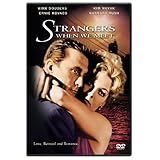
Strangers When We Meet (1960) Review

Strangers When We Meet (1960)
Average Reviews:

(More customer reviews)
"Strangers When We Meet" (1960) is simply a magnificent movie. In this reviewer's opinion, the acting performances from every single member of this first-rate cast are brilliant -- from Kirk Douglas to Kim Novak to Ernie Kovacs to Walter Matthau. They are each just perfect here. Also keep an eye peeled for Sue Ane Langdon, who pops up in a brief cameo role.
And I certainly don't want to leave out Barbara Rush, who gives a knockout portrayal of Douglas' wife. Rush's final emotion-filled scenes in the film are literally worth a replay every time this movie is watched.
Walter Matthau's role in the film is fairly small, but powerful. Walter is thoroughly repulsive here as an aggressively-lecherous, scheming, and oversexed neighbor, who lives just a few doors down from Douglas.
Can you imagine that -- Walter Matthau being deemed "repulsive"? Hardly seems right, does it? But, in this flick, it applies. "Strangers" was made at a time when the then-39-year-old Matthau was playing more serious roles in the movies, and before all of his excellent comic parts. Four years after "Strangers", Matthau played another rather unlikable character, in 1964's "Fail-Safe", which was yet another fine performance by the versatile actor.
It's also kind of funny to note (in an "in-joke" fashion) that Matthau's character's name in "Strangers" is "Felix", which is a name that would be closely associated with Walter in the film "The Odd Couple" (1968), when Matthau's "Oscar" played opposite Jack Lemmon's "Felix".
Douglas and Novak are "strangers when they meet" in the supermarket one day, and they seem to have a genuine chemistry on screen here. I found Kim's "Maggie" in this movie very similar in "icy" and "moody" style to her role two years earlier in Alfred Hitchcock's classic tale, "Vertigo". Both of those Novak characters seem to be forever tormented by some inner demons that can never be fully exorcised. But by the end of "Strangers", Maggie has shed a great deal of her inner anguish, with the film ending in a bittersweet -- but in my opinion very fitting -- fashion.
"Strangers When We Meet", I think I'm safe in assuming, is one of Kirk Douglas' lesser-known efforts during the man's amazing screen career -- but its relative obscurity doesn't make the movie any less powerful. Douglas is 100% believable in his role here as "Larry Coe", an architect who's tired of the drab cookie-cutter assignments that have been served up to him. He wants to design a house that's different. And that's just what he does in the movie.
Throughout the film, we can actually see Larry's uniquely-designed, multi-level house take shape, bit by bit. By the film's final reel, the project is completed, and it's a truly stunning home, in my opinion.
Larry Coe also has a roving eye for his quite fetching and alluring neighbor (Maggie) -- and despite the fact that each of them is married with young children, Larry and Maggie find their mutual attraction to each other too much to resist, and they begin a love affair.
The screenplay for "Strangers" was written by Evan Hunter (based on his novel). The film was directed with great style and obvious "TLC" by Richard Quine (who also doubled as the movie's producer).
The setting is California, circa 1960, and Mr. Quine's excellent use of his beautiful "CinemaScope" widescreen (2.35:1) framing comes through with flying colors on this DVD version of the film. The movie was shot in color and the cinematography for both the outdoor and indoor scenes is rich in colorful details, which this DVD from Columbia/Sony exhibits very nicely.
There's a scene near the end of the movie that's just spectacular (from a photography and lighting standpoint), with a rainbow of colors on the screen at once -- this scene taking place in Larry's just-finished hilltop home, with the light shining through various tinted panes of window glass in a way that's just simply gorgeous.
This adult drama, which is replete with multiple cases of infidelity, could very easily (in my view) have been a real "snooze-fest" (aka: a boring 2-hour nightmare to have to sit through). But, instead, it's exactly the opposite -- it comes across as fresh and alive and interesting, all the way through its entire length of 1 hour and 57 minutes.
Director/Producer Quine and screenwriter Hunter have made these characters compelling and intriguing -- and just flat-out interesting to watch. Quine and Hunter make us care about these people on screen, from beginning to end. And I'm guessing that this wasn't an easy task, given the rather heavy and somber subject matter that the film deals with.
The "suburban" feel of the early 1960s comes across very strongly in the film as well. Each frame of the movie reflects the era in which it was made -- and I don't mean that in a negative way whatsoever; to the contrary in fact. That "feeling" for the era is something I like very much here. The film began playing in movie houses on Wednesday, June 29th, 1960.
I was flabbergasted when I discovered this movie was actually available on the DVD format. It had been on my "Buy When Available" list for many moons; but slipped under my radar of new releases when Columbia/Sony streeted this little gem on February 22, 2005. To say the least, I was most pleased when I was finally able to cross this one off of the "To-Get" list.
This single-disc, single-sided DVD gives us the film in its intended and original 2.35:1 Widescreen video format, and it offers up a dandy-looking Anamorphic (16x9 enhanced) transfer to boot. It just looks great. .... The audio on the disc comes across fine via a 2.0 Dolby Digital Mono soundtrack. Subtitles can be accessed in either English or Japanese.
The DVD comes packaged in an Amaray-type plastic Keep Case. There's no Scene Selection paper insert included in the box; but there is the normal Scene Index included on the disc itself (the film is divided up into a modest number of chapters, totalling 12).
The DVD's Menus are silent and non-animated, with the Main Menu (and "Scene" Menu) sporting an odd, albeit very picturesque, view of the skyline of New York City. (That's "odd" only because the movie is not set in New York, and has nothing whatever to do with that city; the film is set entirely in California. And what makes the DVD Main Menu picture of NYC even more peculiar is the fact that it depicts the World Trade Center as part of the New York skyline; the WTC wasn't completed until more than a decade after "Strangers" was made. Oh, well, it's still a nice-looking Menu photo nonetheless. A portion of that same New York skyline picture is also used for the DVD's front cover; the packaging photo is cropped, however, and lacks the World Trade Center image.)
The only "Bonus" material on the DVD are three "Previews" (Trailers). But, unfortunately, the original theatrical trailer for "Strangers When We Meet" is not included.
-----------------
To Sum It Up.........
"Strangers When We Meet" is highly recommended -- both the film and this DVD. Anyone who is a fan of intelligently-written motion-picture dramas -- or a fan of Kirk Douglas or the always-lovely Kim Novak -- will have no choice but to admire "Strangers" (IMHO).
If you haven't done so already, take "Strangers" for a spin in your DVD Player as soon as you can. It's a 117-minute journey back to 1960 -- and it's worth the time spent making the trip.

Click Here to see more reviews about: Strangers When We Meet (1960)


Buy Now

Click here for more information about Strangers When We Meet (1960)

Read More...

Reckless (1999) Review

Reckless (1999)
Average Reviews:

(More customer reviews)
I recently purchased this DVD set on a whim and was absolutely captivated by it. It was funny, romantic, touching, sad, suspenseful. All the actors were magnificent, especially the 3 leads. I tried to drag it out 3 nights but found I just couldn't. I finally gave in - it was like devouring a guilty pleasure in one sitting. Surfed the web and found Reckless, the Sequel, and ordered it sent 2-day priority mail. Get them both at the same time - the sequel is just as wonderful. This series reminded me what a joy good entertainment can be.

Click Here to see more reviews about: Reckless (1999)

This four-disc set includes the hit romantic dramas Reckless and Reckless: The Sequel, starring Francesca Annis (Wives and Daughters), Robson Green (Touching Evil), and Michael Kitchen (Mrs. Dalloway). Watch romance try to stay on track through trysts, treachery, and trouble, and follow the complex and emotional decisions of the three who are involved in one very complicated love triangle.In Reckless, Owen Springer (Robson Green) is a young doctor who has just moved to Manchester to take care of his demanding, hypochondriac father.The last thing he is looking for is an affair...until he meets Anna (Francesca Annis).However, there are two obstacles on Owen's path to happiness with Anna--she is several years older, and she is married.Undaunted, Owen sets out to charm her, and just when he's beginning to get somewhere, he's hit with a bombshell.Anna's husband is his new boss at the hospital.In Reckless: The Sequel, Anna has divorced her husband, Richard (Michael Kitchen), and Anna and Owen have made an impetuous decision to marry--at the end of the week. The idea is to have the ceremony while Richard is out of the country, but he hears of their plans and flies back to England. Still in love with Anna, he is determined to save her from what he sees as a potentially disastrous marriage. Will Anna actually marry Owen?Special DVD features include: link to the Masterpiece Theatre Web site; scene selections; and closed captions.On four DVD5 discs.Region coding: All regions.Audio: Dolby stereo.Screen format: 4 x 3 full frame.

Buy NowGet 47% OFF

Click here for more information about Reckless (1999)

Read More...

The Unbearable Lightness of Being (Two-Disc Special Edition) (1988) Review

The Unbearable Lightness of Being (Two-Disc Special Edition) (1988)
Average Reviews:

(More customer reviews)
Phillip Kaufman reached an artistic pinnacle with this elegant translation of Milan Kundera's book about the 1968 Czechoslovokian crisis. Daniel Day-Lewis plays Tomas, a physician, whose life consists in seducing women, one of whom - an artist Sabina (Lena Olin) - is his sexual and spiritual soulmate. Into his life comes another woman, Terezina, (Juliette Binoche) who demands more of a committment to her than he will permit to any woman including Sabina. His crisis between the carefree artist and the more demanding Terezina mirrors the crisis of Czechoslovokia between the "liberation" of the Prague Spring and the Soviet repression of August 1968 although neither Kauffman nor Kundera crudely makes Sabina represent the one nor Terezina the other. Although these characters may lead apparently amoral lives, the film and novel are all about the moral consequences of their choices. Many American critics, similar to the one who provided the first customer review, feel that Kaufmann has simply made a piece of arty Euro-lite soft-core: intellectual and opaque enough to appeal to the high-brow crowd yet tittliating enough to strike at their lowbrow desires. While I'll concede that this judgement applies well to his follow-up film "Henry and June" (1990), it's grossly unfair to characterize this film as such. The narrative and themes are presented clearly, the cinematography is gorgeous but never in an overly-arty way like in "Henry and June", and his whirling direction keeps this film moving along at an effervescent 172 minutes. The actors - especially Day-Lewis and Olin - do phenomenal work and contribute mightily to bring Kaufmann's evocation of late 1960's Europe to life. In a strange way, the film compliments the book rather than adapts it and stands on its own as a fully realized cinematic work.
People conditioned to see sex on the screen as a smutty joke or leading to painful reprecussions had problems with Kaufmann's playful sensuality here. He compounded their discomfort by coating all these goings-on with a veneer of class, larding the film with literary references and putting Janacek on the soundtrack. And it was easy to dismiss the film as nothing but a bunch of amoral European sophisicates who make love in between bouts of literary discussions or fighting political repression. But the film pulls us into these character's lives in a much more impassioned and alive way than European art cinema does with its deliberate distancing effects and pretentious moralizing (good recent example: Lars Von Trier's interminable "Breaking The Waves"). The film weaves its larger concerns about freedom and responsibility seamlessly through the narration - we can follow the film without knowing all the allusions and references. Some may see the characters and their bed-hopping as shallow and affected but they are forced to deal with their country's politics and history and have to come to terms with their own lives in ways that Euro-fluff soft-core comedies like "French Twist" never have to. Indeed, the moral choices placed on these apparently frivolous characters gives the film its greatness.
In other words, "Unbearable Lightness" has a sophisticated air because it is sophisticated: in its ideas, direction, writing, and acting. Kaufmann's work since has generally disappointed but here he's made one of the richest and intelligent films of the decade.

Click Here to see more reviews about: The Unbearable Lightness of Being (Two-Disc Special Edition) (1988)

Let others in 1968 Prague fret over liberty and the pursuit of happiness. Prague surgeon and avowed womanizer Tomas is focused on the happiness of pursuit. He's determined to live with a lightness of being unfettered by things like commitment and Communism. A young doctor's quest for sex and his stumbling into love are part of the rich storyline of this lyrical film from the landmark Milan Kundera novel, produced by Saul Zaentz (The English Patient, Amadeus) and directed by Philip Kaufman (The Right Stuff, Henry & June). Daniel Day-Lewis, Juliette Binoche and Lena Olin indelibly form the romantic triangle at the center of Tomas' world. It's a shifting world of hope spoiled and renewed, of lives blighted by oppression and reinvigorated by deep, maturing love. DVD Features:Audio Commentary:Commentary by Philip Kaufman, Jean-Claude Carriere, Walter Murch and Lena Olin Audio Commentary:Commentary by Philip Kaufman, Jean-Claude Carriere, Walter Murch and Lena Olin Documentaries:Emotional History: The Making of Unbearable Lightness of Being Theatrical Trailer


Buy NowGet 24% OFF

Click here for more information about The Unbearable Lightness of Being (Two-Disc Special Edition) (1988)

Read More...